
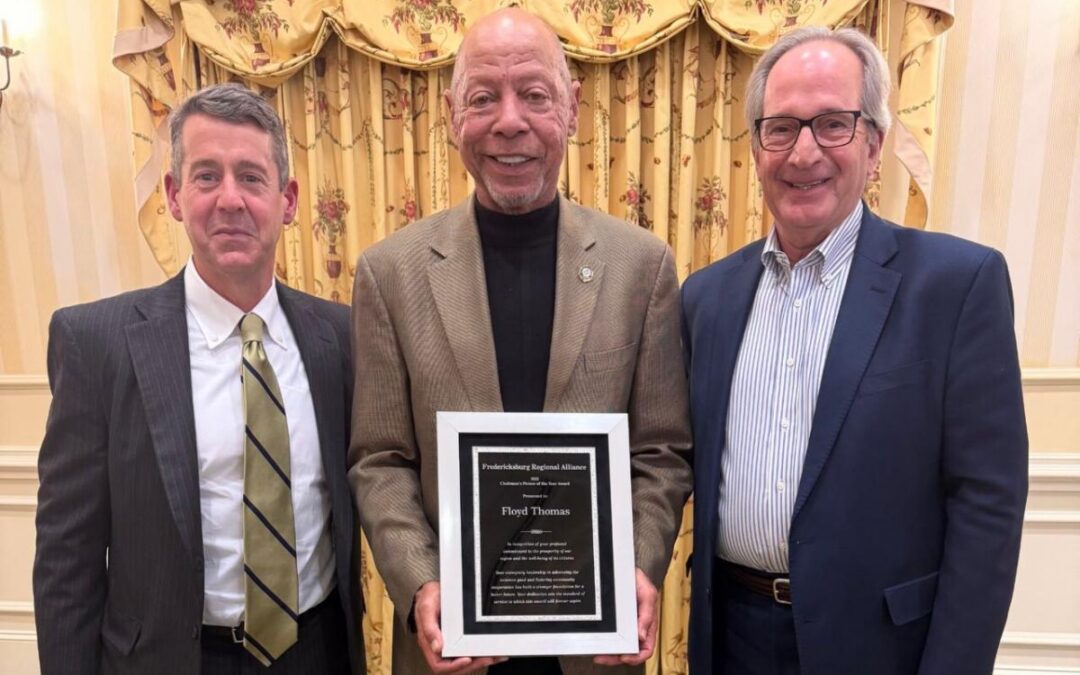
When Floyd Thomas was a child, he already knew where he wanted to live.
His family roots in Caroline County stretch back generations, and although Thomas was born in New York, summers regularly brought him back to Virginia. He remembers waving to people sitting on their porches and being amazed when they waved back, even though they didn’t know him.
“I really love this place,” Thomas remembers thinking. “I want to live here when I grow up.”
His family had one very practical question: Where are you going to work?
It’s a question that, decades later, gets to the heart of Thomas’ work as a member of the Caroline County Board of Supervisors and the Virginia’s Innovation Crossroads Board.
Today, his answer would be very different.
Creating opportunity at home
Thomas has served on Caroline County’s Board of Supervisors since 1991, giving him a front-row seat to more than three decades of change. During his tenure, he has watched the county add thousands of jobs ranging from entry-level positions to highly technical careers – while also investing in schools, public safety and infrastructure that are important to residents’ quality of life.
For Thomas, that evolution is personal.
He earned a degree in architecture, but his career took him into computer-aided design and technology. When he finally moved to Caroline in the 1980s, working in Northern Virginia meant a long commute. At home, connecting remotely was initially impossible because Caroline’s telephone system still relied on pulse dialing, a dated technology that couldn’t communicate with his modern modem.
Fast forward 40 years, and the picture is dramatically different.
Thomas helped work toward expanding broadband access in Caroline, with fiber soon expected to make high-speed internet available throughout the county. That means a resident can live in Caroline and potentially work for an employer virtually anywhere.
But the bigger economic development story is how that infrastructure can elevate Caroline in the eyes of potential investors.
Today, the county features major employers such as M.C. Dean, McKesson and World Class Distribution, which offers jobs across the skills spectrum. Thomas sees an important role for education and workforce training in preparing residents for those opportunities, particularly as Caroline pursues more technology-driven businesses and skilled professional trades.
“Building a better world is still my philosophy,” Thomas said, “just through providing opportunities through economic development that create an environment for success for everyone.”
A blank canvas for what comes next
Caroline’s location has long been one of its biggest assets. Interstate 95, U.S. Route 1 and U.S. Route 301 put the county within easy reach of major East Coast markets.
But Thomas points to another asset that could be just as important – room to build what comes next.
Caroline still has large areas available for economic development, places that Thomas describes as “blank canvases” where companies can envision their operations growing and thriving.
“We haven’t committed to everything yet,” he said. “We have several places where we can have an open mind for what’s coming, what could come.”
That doesn’t mean growth everywhere.
Caroline has deliberately concentrated much of its development along the Route 1 corridor, where infrastructure can support new businesses and residential growth. Thomas sees that approach as a way to create jobs and expand the county’s tax base while preserving the rural character that residents value elsewhere.
“Growth should mean opportunity and preservation,” said Thomas, who represents the county’s central district where a lot of its growth is occurring. “It’s a very delicate balance.”
Stronger at the crossroads
Thomas sees a similar balance of assets and opportunities on a regional scale, with the newly rebranded Virginia’s Innovation Crossroads giving Caroline, Fredericksburg, Stafford and Spotsylvania new opportunities to market themselves collaboratively. That regional teamwork is critical as investors start by looking at regions rather than individual localities.
Consider, for instance, “there’s that one business that’s looking at Stafford, Spotsylvania, Caroline,” Thomas said. Instead of fighting over that single prospect, he argues, the region can work together to attract more opportunities. “There’s four or five businesses out there. If we work together, we can get all five.”
Decisions being made today will take years to fully unfold. But growth already on the books – from expansions by existing businesses to planned data centers – will generate both jobs and tax revenue that help Caroline invest further in schools, public safety and other community priorities.
And that brings Thomas back to the question his family asked him all those years ago.
If you choose Caroline, where will you work?
Increasingly, the answer is: right here.
And for Thomas, the more interesting question now may be what comes next.